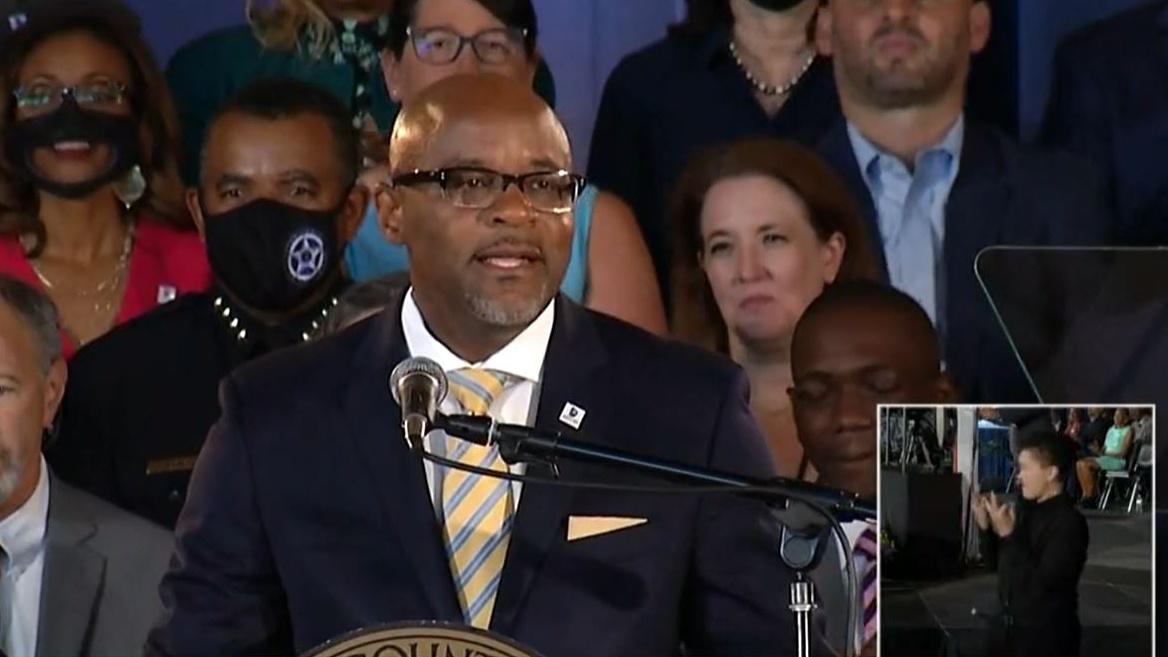
In the first section of the speech, which was also the shortest, Hancock said “we must hold true to the values of Denver.” Hancock said those trying to spread hate or sew division “must be overcome by collective voices and acts of unity.”
The second section of the speech focused on the city’s economy and housing. It was the longest portion of Hancock’s address.
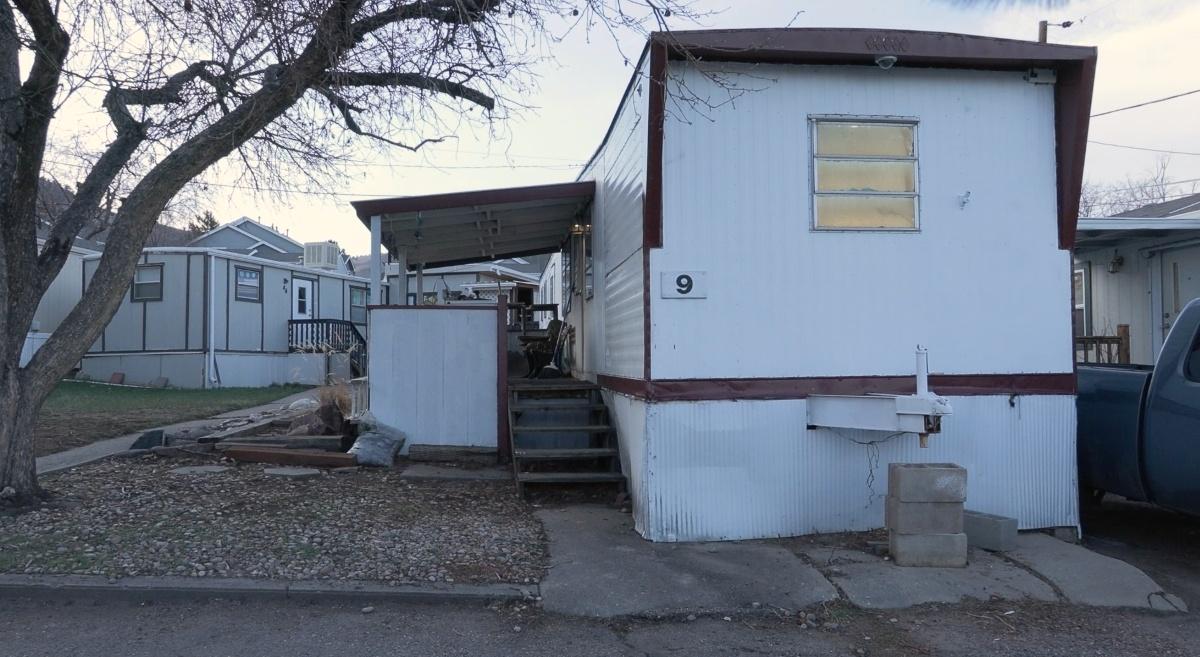
Hancock said “we will not be satisfied until everyone is housed,” while adding that the conflating factors of COVID-19, the nationwide housing crisis, the opioid crisis and unaddressed mental health problems have made housing and homelessness a major problem that needs solving in Denver.
“When it comes to encampments, we’re pursuing every strategy we can to address the injustice of people living on the streets … The solutions are not simple, and anyone who says they are fails to grasp the reality of the challenge,” Hancock said. “My vision — and I know you share this vision — is for a city where far fewer people live on our streets.”
Hancock made no direct mention of “sweeps,” the controversial practice of clearing homeless encampments in Denver. A recent study in Denver found that sweeps are not an effective tool to encourage people to move into more stable housing. Hancock did, however, say the city “can do a better job moving people off the streets and into stable housing, and not just down the street to another encampment.”
“Our outreach efforts will become more intensive, more focused on rehousing people living in the encampments that grew during the pandemic,” Hancock said. “This will remain a top priority for the coming year, because what we are seeing on our streets is an unjust humanitarian crisis.”
Hancock touted the success of “tiny homes” programs and announced that he is submitting a proposal to City Council that will direct $2 million of funding from the American Rescue Plan Act to the Denver Basic Income Project, which provides direct cash payments to people experiencing homelessness.
[Related: Denver's newest tiny homes receive a big send-off from the students that built them]
In the third section, Hancock discussed the need for climate action, saying it is a “race to save our future.”
As we have seen in recent years, the human-caused warming of the planet is leading to worsening drought, heat waves and fire conditions.
[Related: Climate change and population growth creating conditions for more fires like the Marshall Fire]
“Every day, every hour, every minute we delay means we are sacrificing our children’s future. That is an unacceptable injustice. We can and must do better,” the mayor said.
Hancock mentioned the city’s wildly successful Climate Action Rebate program, which incentives residents to switch over to “greener” technologies for their homes and lifestyles, like heat pumps, solar panels and e-bikes. The program has been so popular that it has led to crashes on the city’s website.
Hancock’s fourth section focused on public safety and “better policing.” He began by calling the debate over more or less police in the city a “false choice.”
“It’s about better policing,” the mayor said. “Our residents should feel safe in their communities and safe to interact with our officers.”
The Sunday before the State of the City Address, five people in downtown Denver were injured when police officers shot a man that the officers said was armed. The man was not killed, and the bystanders are expected to recover from their injuries. In his address Monday, Hancock said, “The expectations of policing and public safety have fundamentally changed over the past decade, and rightfully so.”
The mayor added that the city needs to expand its STAR program, which dispatches behavioral health clinicians and emergency medical technicians, not police, to nonviolent crisis situations. However, some community members have felt excluded from STAR’s expansion in the past.
Hancock’s final section briefly touched on the importance of education in the city.
“Denver Public Schools has the responsibility of supporting Denver’s kids while they’re in the classroom,” Hancock said. “Outside of school doors, we all need to be there for every child. We must remain committed to that compact with DPS, so every child has everything they need to thrive. Justice for our children is a future full of possibilities.”
Hancock added that the city’s first Youth Empowerment Center is now open and that four more will follow by 2024.
Concluding his speech, Hancock said “a city is a constant work in progress.”
“We build on the progress that came before us. We change. We re-invent. We try new things. And that work is never done,” Hancock said. “A year from now, I will hand these duties on to the next mayor. Every day until then is a new opportunity to improve the lives of every Denver resident.”
Kyle Cooke is the digital media manager at Rocky Mountain PBS. You can reach him at kylecooke@rmpbs.org.