History Colorado is a nonprofit that is an extension of the Colorado Department of Higher Education. The Colorado State Historian position focuses on broadening the meaning of multiple historical perspectives.
Although Garcia is not a historian by occupation, her specialties in creative writing and philosophy inform how she approaches the telling of history.
“I consider history stories, and not a set of facts,” said Garcia.
To that end, one of her fist projects in her new role is History Colorado’s Blaxplanation, which focuses on the African-American experience in Colorado through diasporic and political contexts rather than the trauma of African-American enslavement. Garcia said she is on the search committee for hiring a curator for Black history, a key position in terms of building up the archives as well as helping History Colorado plan future exhibitions.
Garcia also researches and writes about multiracial and multicultural democracies. With the upcoming 250th anniversary of the Bill of Rights she finds herself asking, “What does a genuinely multicultural, multi-ethnic democracy look like in the 20th century?
As a longtime educator, Garcia emphasized that learning about history, even the parts that may be traumatizing and graphic such as the oppression of African-Americans, is crucial to be taught in schools. She believes Florida Governor Ron DeSantis signing a bill into law that bans critical race theory in Florida, for example, is damaging to education.
“I’m especially excited to start in the Colorado State Historian position at a time when history is being really contested and debated from kindergarten up through higher [education] as well as just around dinner tables,” she said.
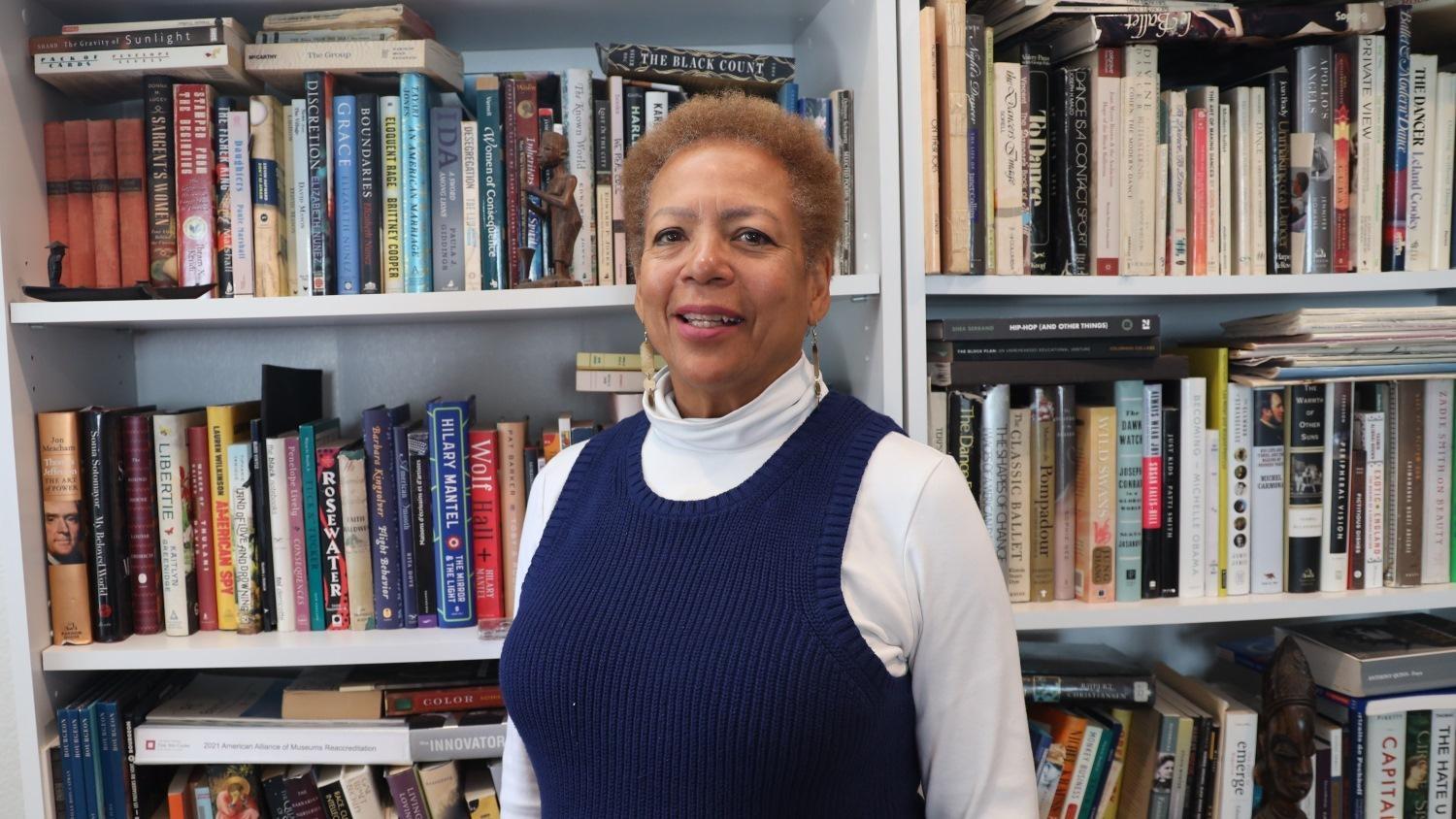
Garcia’s love for stories starts with her family. Growing up, her childhood home was filled with magazines and books. At her sun-filled home, she showed off an impressive bookshelf filled with books African artwork. Family photos and cultural art from around the world line the living room walls — not a surprise from a woman who has a deep love for history.
She shared that her mother, Dolores Ferguson, was “a dreamer.” Ferguson moved to Paris to pursue her dreams as an artist despite growing up in a time of segregation and poverty in Alabama. Garcia said that her father, Clarence Clyde Ferguson, introduced the family to entrepreneurship, activism, and higher education.
“So, I’m grateful to my family for giving me not only a love of reading but also a love of traveling,” she said.
In Garcia’s early 20’s she worked for television as a field producer for arts and culture at GBH in Boston.
“Which was the perfect job for me because it meant that I got to go out in the field and interview mostly writers but occasionally ballet dancers or other creative people and turn them into stories,” she said.
Garcia calls herself an interdisciplinary scholar who focuses on hidden and underappreciated literature and poetry produced by African-American women. Anna Julia Cooper is one of her favorite writers from the late 19th and early 20th centuries.
“Just as our past is shared, our future is shared,” Garcia said. “And knowledge, as Anna Julia Cooper said, is power.”
Lindsey Ford is a multimedia journalist at Rocky Mountain PBS. You can reach Lindsey at lindseyford@rmpbs.org.




.jpg)